
Balloon Shalwar Guide: Design, Fit, 7 Types and Modern Pakistani Styles
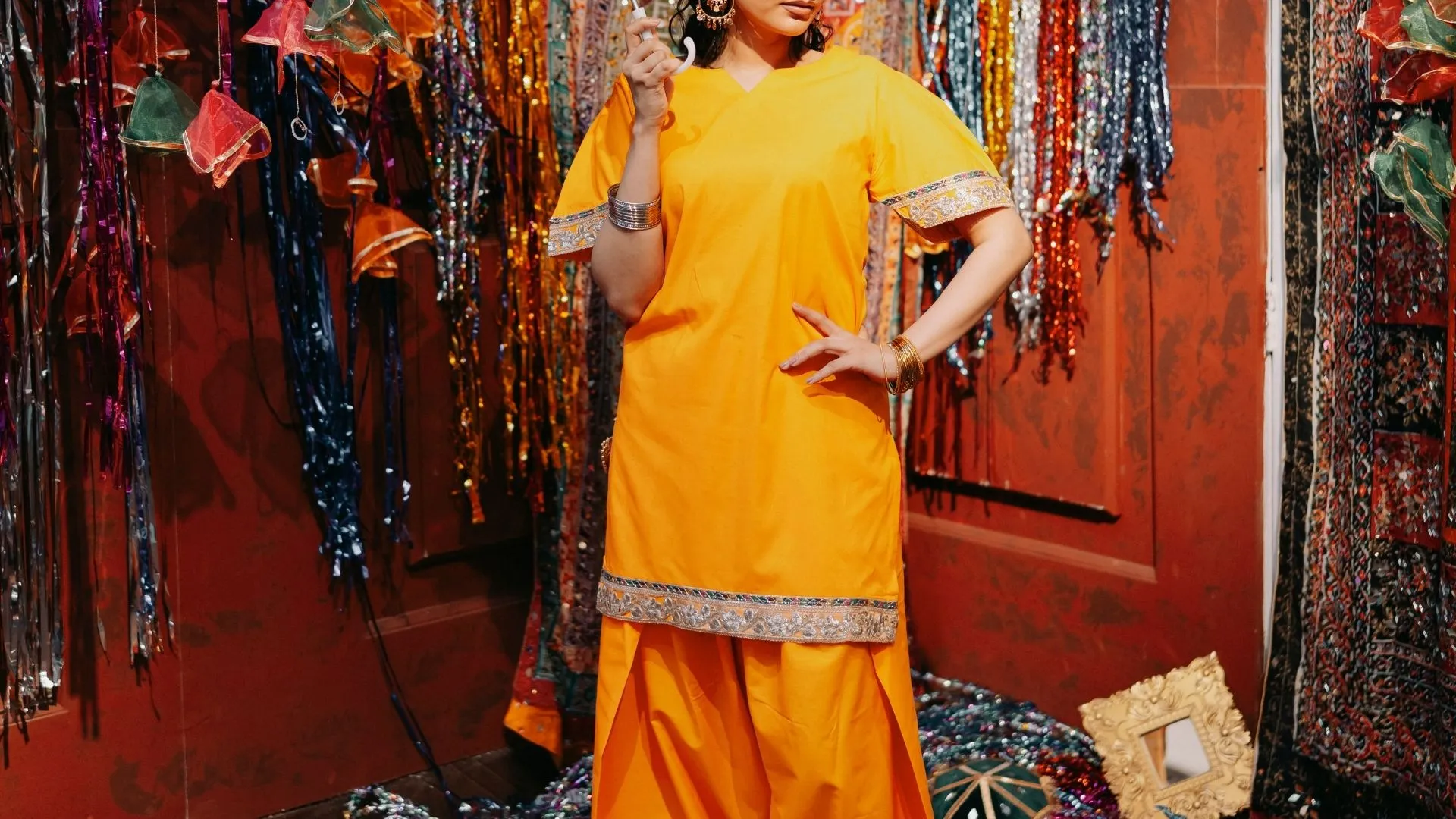
Balloon shalwar is a full, rounded lower garment that carries substantial volume through the legs and becomes narrower near its lower opening. The cut creates a different shape from straight trousers, regular shalwar and farshi shalwar. In modern Pakistani clothing, it is commonly paired with a loose-fit shirt in a stitched two-piece or three-piece set.
The design is defined by construction rather than colour, print or decoration. A balloon shalwar may be plain, printed, panelled or coordinated with a matching shirt. However, it must retain the rounded leg structure and controlled lower opening that produce its distinctive shape.
Modern Pakistani versions use traditional shalwar principles with updated proportions. Drop-shoulder shirts, half sleeves, simple necklines, printed fabrics and coordinated sets are frequently combined with the fuller lower garment. This balloon shalwar guide explains its design, fit, main types, fabrics and differences from similar trousers.
Table of Contents
- What is a balloon shalwar?
- Background of the balloon-shaped trouser
- Main balloon shalwar design features
- How balloon shalwar should fit
- Seven important balloon shalwar types
- Balloon shalwar compared with other trousers
- Suitable fabrics and prints
- Modern Pakistani balloon shalwar styles
- How to evaluate construction quality
- Frequently asked questions
What Is a Balloon Shalwar?
A balloon shalwar is a loose lower garment shaped to create fullness through the upper and middle legs before narrowing towards the hem. The rounded form may be produced through fabric volume, gathers, pleats, panels, darts or curved seams.
The waistband controls the upper section. Below it, the garment expands rather than following a straight trouser line. The lower section then narrows through pattern shaping, gathering, a cuff or an elasticated finish. This difference between the wide body and controlled lower opening creates the balloon effect.
Not every loose shalwar is a balloon shalwar. A traditional shalwar is generally wide around the waist and thighs but may fall more directly before gathering at the ankles. A balloon design gives greater attention to the curved shape of the complete leg.
The term may also be used internationally for balloon trousers or curved-leg pants. However, a Pakistani balloon shalwar remains connected to the shirt-and-shalwar structure of eastern clothing. The cut is normally designed as part of a coordinated suit rather than as an independent Western trouser.
Background of the Balloon-Shaped Trouser
Loose trousers with fabric gathered or controlled at the lower leg have existed in different regions under names such as shalwar, salwar, sirwal and harem trousers. These garments developed through regional tailoring systems and should not all be treated as one identical design.
The general history of shalwar kameez shows that shalwar cuts vary widely across South Asia and neighbouring regions. Some are extremely loose, some narrow at the ankle, and others use regional pleating or cuff construction.
International fashion has also adopted rounded and tapered trousers under terms such as balloon pants and barrel-leg pants. Recent fashion reporting describes balloon trousers as full through the leg and narrowed towards the ankle, which matches the general construction principle behind the name.
The modern Pakistani balloon shalwar should still be evaluated within local eastern clothing. Its shirt proportions, waistband construction, fabric selection and stitched set format distinguish it from jeans, casual balloon pants and Western barrel trousers.
Main Balloon Shalwar Design Features
Rounded Leg Shape
The main feature is the rounded leg. The garment expands below the waist or hip area, maintains width through the middle and then becomes narrower towards the lower opening.
This shape must be visible when the garment is worn normally. If it appears wide only when spread flat, the pattern may not contain enough shaping to create a proper balloon structure.
Generous Fabric Volume
A balloon shalwar needs more fabric than a straight trouser. The additional material creates room through the legs and supports the rounded form.
The amount of fabric must remain controlled. Too little fabric removes the balloon effect, while excessive fabric can create uneven bulk around the waist. A good pattern distributes volume through the complete leg rather than placing it in one area.
Gathered or Structured Waistband
The waistband brings the upper fabric into a secure waist section. It may use elastic, a drawstring, a fixed band or a combination of these methods.
Gathers should be distributed consistently. Heavy bunching at the front or back can affect the fit and prevent the leg shape from appearing balanced.
Narrower Lower Opening
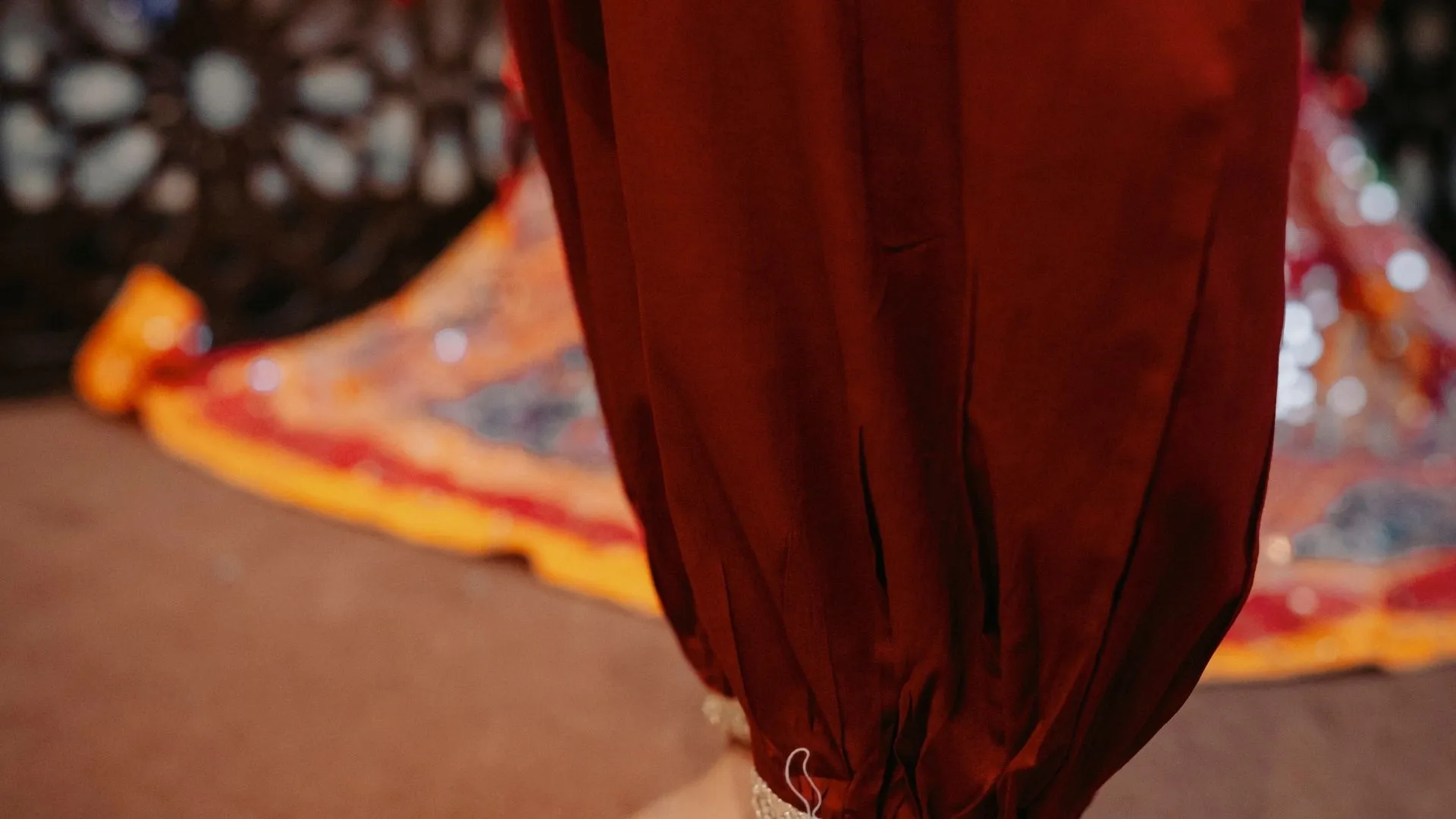
The lower opening is smaller than the widest part of the leg. It may finish with a stitched band, elastic, pleats, darts or pattern tapering.
The opening should be wide enough for practical use while remaining narrow enough to support the rounded design. If the hem remains completely broad, the garment becomes closer to a farshi or wide-leg trouser.
Curved or Panelled Construction
Some designs use curved side seams to create volume through the middle of the leg. Others use separate panels, darts or controlled pleats.
Panel construction can help designers position volume more accurately. It is also useful with printed fabric because the direction and distribution of motifs can be managed across individual sections.
Balanced Shirt Proportion
A balloon shalwar is commonly paired with a loose-fit shirt, short kurti or medium-length kameez. The shirt should work with the volume below instead of hiding the complete lower garment.
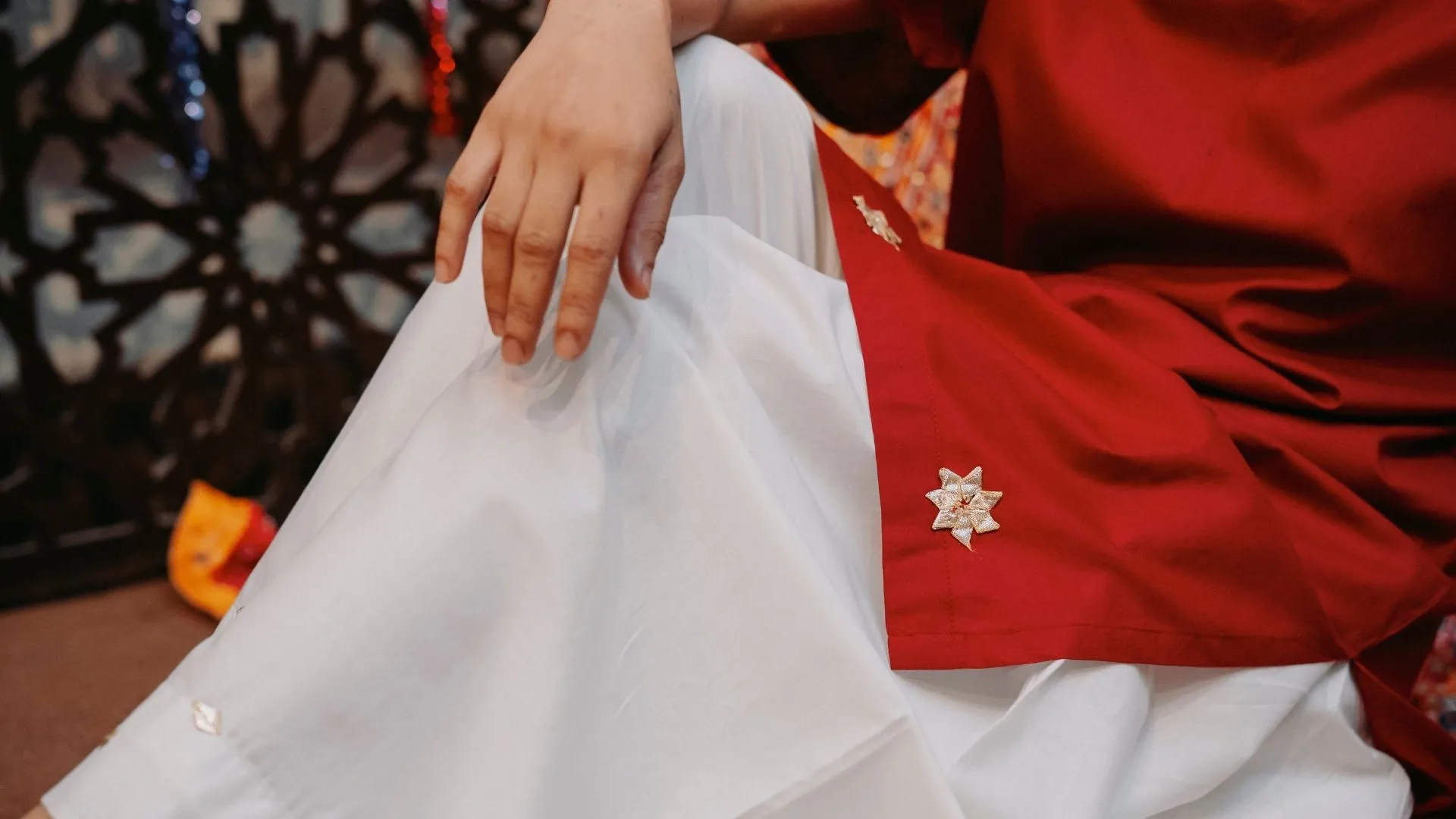
Modern shirts may include drop shoulders, half sleeves and simple necklines. Clean upper construction prevents the outfit from becoming overloaded with too many competing details.
 How Should a Balloon Shalwar Fit?
Balloon shalwar fit should be assessed through the waistband, leg room, lower opening and relationship with the shirt. It is not intended to follow the fitted structure of narrow trousers.
Waistband Fit
The waistband should remain secure and sit flat. It must support the garment without twisting or allowing the gathers to shift heavily towards one side.
Elastic should recover properly after stretching. A drawstring should move smoothly through its casing and remain firmly attached at its ends.
Upper and Middle Leg Fit
The upper and middle sections should provide visible room. The fabric should not pull tightly across the thighs because this prevents the balloon shape from developing correctly.
Extra room should be distributed around the leg. A design that places all its volume on the outer side can look uneven from the front and back.
Lower-Leg Fit
The garment should begin narrowing before its final opening. This taper may be gradual or more defined depending on the pattern.
The lower section should not become so tight that it restricts normal use. At the same time, an overly broad opening weakens the rounded appearance.
Overall Length
Length affects where the lower volume sits. If the garment is too short, the narrowing may finish higher than intended. If it is too long, excess fabric can collect heavily above the lower opening.
A correctly balanced length allows the rounded section to remain visible without excessive fabric collapsing at the hem.
Shirt and Shalwar Balance
Loose shirts often work well with balloon shalwar because both pieces use relaxed construction. However, their volume must remain controlled. A shirt that is extremely long and broad can cover the design of the shalwar.
Drop shoulders and half sleeves can reduce unnecessary structure around the upper garment. A round or V-neckline adds definition to the front without requiring heavy decoration.
 7 Important Balloon Shalwar Types
1. Classic Rounded Balloon Shalwar
The classic design carries volume from the upper leg into a rounded middle section before narrowing towards the bottom. It may use curved seams or controlled tapering.
This type presents the clearest balloon shape. Plain fabric is often used because it makes the construction easier to see. The waistband, leg curve and lower opening therefore need accurate stitching.
2. Gathered-Waist Balloon Shalwar
A gathered-waist version uses a wide upper pattern that is reduced into the waistband through small gathers or pleats. This creates additional fabric through the upper leg.
The gathers must be evenly placed. Excessive concentration at the front can create unwanted thickness, while too little gathering may make the design look like a straight trouser.
This balloon shalwar type may use elastic or a drawstring waistband. Both systems should be enclosed cleanly and provide consistent support.
3. Panelled Balloon Shalwar
Panelled construction uses separate fabric sections to develop the rounded leg. Panels may be straight, angled or curved depending on the required shape.
This technique gives greater control over where the garment expands and narrows. It can also improve the distribution of print across the lower garment.
Panel seams should remain flat and secure. On plain fabrics, irregular seams become noticeable quickly because there is no print to reduce their visibility.
4. Tapered Balloon Shalwar
A tapered balloon shalwar achieves its rounded form mainly through the pattern. It begins wide and gradually becomes narrower towards the lower leg.
This version can have a cleaner finish than heavily gathered designs. The narrowing should remain consistent on both legs, and the lower opening should not twist.
Tapered designs may appear closer to barrel-leg trousers, but their use with a Pakistani shirt and traditional waist construction keeps them within the balloon shalwar category.
5. Cuffed Balloon Shalwar
The cuffed version uses a defined band or controlled finish at the bottom. The wider leg is gathered, pleated or shaped into this narrower section.
A cuff gives the lower opening a clear structure. It must be attached evenly so the gathers do not collect more heavily on one side.
Some cuffed designs use elastic rather than a fixed band. Elastic creates a softer lower finish, while a stitched cuff produces a more structured result.
6. Plain Balloon Shalwar Two-Piece Set
A plain two-piece set coordinates the rounded shalwar with a matching shirt. The design relies on colour, proportion and construction instead of print.
The maroon balloon shalwar two-piece set pairs a full balloon shalwar with a loose-fit shirt, drop shoulders, half sleeves and a round neckline with button detailing.
A light pink balloon shalwar two-piece set presents another plain version with a loose shirt and V-neckline. These examples show how neckline and colour can change while the main lower construction remains consistent.
7. Printed Balloon Shalwar Three-Piece Set
Printed designs introduce pattern across the shirt, shalwar or supporting piece. The print must be positioned carefully because the rounded lower garment may use several panels or curved seams.
The off-white and rust printed balloon shalwar three-piece set combines a printed design with a loose-fit shirt, drop shoulders and a round neckline with lace detail.
A printed balloon shalwar requires more attention during cutting. Major motifs should follow a consistent direction, while visible borders should align wherever the pattern construction permits.
Balloon Shalwar Compared With Similar Trousers
| Garment | Upper Section | Leg Shape | Lower Opening | Main Difference |
|---|---|---|---|---|
| Balloon shalwar | Loose or gathered | Full and rounded | Narrower than the middle | Volume forms a curved leg |
| Regular shalwar | Wide at waist and thighs | Loose with a more traditional fall | Usually gathered or cuffed | Less emphasis on a rounded middle |
| Farshi shalwar | Gathered or panelled | Very wide through the lower section | Broad and floor-level | Does not narrow into a balloon shape |
| Patiala shalwar | Heavily pleated | Draped with layered folds | Narrow ankle finish | Defined by numerous pleats |
| Harem trousers | Dropped or loose rise | Very loose through the leg | Usually narrow or elasticated | May use a lower crotch and non-Pakistani top |
| Palazzo trousers | Flat or lightly gathered | Straight or gradually wide | Broad | Does not taper at the bottom |
| Barrel-leg trousers | Structured waist | Curved outer leg | Tapered | Usually constructed as Western trousers |
The most important comparison is between balloon and farshi shalwar. A balloon shalwar becomes narrower near the lower leg, while a farshi shalwar remains broad towards the floor. The complete farshi shalwar guide explains that separate construction in greater detail.
Fabrics for Balloon Shalwar Designs
Fabric weight affects how clearly the rounded shape appears. Material that is too thin may collapse and lose its structure, while excessively thick fabric can create unwanted bulk around the waistband.
Lightweight cotton and lawn blends can be used for softer balloon designs. The pattern may require sufficient volume or panel shaping to maintain the rounded form in lighter fabric.
Medium-weight cotton blends provide more structure. They support curved seams, pleats and tapered legs without becoming too heavy around the waist.
Linen blends and lightly textured fabrics can create a defined shape, but their thickness must be considered when adding gathers. Large quantities of firm fabric may produce a bulky waistband.
Silk and silk-like materials create a softer finish but require accurate cutting. Slippery surfaces can shift while curved seams and panels are stitched.
Print placement should be reviewed before cutting. The garment’s curved structure can change how stripes, borders and directional motifs appear. Small repeated prints generally distribute more consistently across the leg.
Pakistan’s fabric traditions include extensive regional knowledge in weaving, printing, embroidery and dyeing. The collection presented through Pakistan’s first dedicated textile museum demonstrates the range and technical importance of Pakistani textiles.
Modern Pakistani Balloon Shalwar Styles
Modern Pakistani balloon shalwar styles commonly use a coordinated loose shirt. The shirt may have drop shoulders, half sleeves and a plain neckline. This keeps the upper garment clean while the lower construction provides the main design feature.
Monochrome sets use one colour across both garments. The absence of print makes the rounded shalwar, shoulder line, sleeve construction and neckline easier to examine. Maroon, navy blue, light pink and neutral colours can all be used without changing the garment category.
The navy blue balloon shalwar two-piece set provides a dark-colour option within the same modern shirt-and-shalwar format. A consistent colour across both pieces keeps attention on their cut.
Printed versions may use earthy, floral, abstract or geometric patterns. The design should remain controlled so that print does not conceal poor panel alignment or uneven gathering.
Two-piece balloon shalwar sets keep the focus on the shirt and lower garment. Three-piece sets add another coordinated element while retaining the same main shalwar construction.
The continuing use of rounded trousers in both Pakistani and international fashion shows that the basic form can be updated without removing its core structure. However, Pakistani designs remain distinct through their eastern shirts, coordinated fabric and shalwar-based construction.
How to Evaluate Balloon Shalwar Quality
Begin with the waistband. It should be firmly attached, evenly gathered and free from twisting. Elastic or drawstring components should remain properly enclosed.
Next, inspect the leg shape. Both sides should carry similar volume, and the curve should appear consistent from the front, side and back. One leg should not look wider or longer than the other.
Curved seams and panels must lie flat. Puckering along the seam can affect the rounded form and indicate that the sections were stretched or joined unevenly.
Review the lower opening. Cuffs, elastic or tapered hems should match on both legs. Gathers should be distributed consistently around any attached band.
The shirt must also be evaluated as part of the set. Shoulder seams, neckline finishing, sleeve length and shirt hem should remain balanced. A loose shirt should appear intentionally cut rather than simply oversized.
Printed garments require an additional check for motif direction. Major patterns should not appear upside down, and obvious borders should not be broken unnecessarily at visible seams.
Frequently Asked Questions About Balloon Shalwar
What makes a shalwar a balloon shalwar?
A balloon shalwar has substantial volume through the upper and middle legs before becoming narrower near the bottom. This produces a rounded shape that differs from straight and wide-leg trousers.
Is balloon shalwar the same as harem trousers?
No. The two designs may both use wide legs and narrow lower openings, but harem trousers can have a much lower crotch and are not necessarily paired with a Pakistani shirt. Balloon shalwar follows eastern suit construction.
What is the difference between balloon and farshi shalwar?
Balloon shalwar narrows towards its lower opening. Farshi shalwar remains broad near the floor and may use considerably more width at the hem.
Is balloon shalwar fitted around the legs?
No. It is intended to provide room through the legs. The garment becomes controlled near the bottom but should not fit like a narrow trouser.
Can balloon shalwar be printed?
Yes. Printed fabric can be used, but motif direction and seam placement must be considered carefully because the garment may contain curved panels or tapered sections.
Can a balloon shalwar be part of a three-piece suit?
Yes. It can be used in both two-piece and three-piece sets. The number of coordinated garments does not change the defining rounded construction of the shalwar.
How is balloon shalwar different from Patiala shalwar?
Patiala shalwar is defined by numerous pleats and layered folds. Balloon shalwar is defined by its rounded leg shape, which may be produced through curved seams, panels or tapering instead of heavy pleating.
Understanding Balloon Shalwar as a Modern Pakistani Design
Balloon shalwar combines a full rounded leg with a controlled lower opening. Its construction may use gathers, panels, curved seams, cuffs or tapering, but the complete shape must remain recognisable.
Modern Pakistani versions commonly pair the shalwar with loose-fit shirts, drop shoulders, half sleeves and simple necklines. Plain coordinated sets keep attention on construction, while printed versions add surface detail that requires accurate cutting.
Explore balloon shalwar suits and other stitched eastern clothing through the YASHAM® online shop. Visit the official YASHAM® website for complete product information and follow YASHAM® on Instagram for product photographs and collection updates.