
Popular Embroidery Styles in Pakistani Women’s Clothing
Embroidery styles in Pakistani women’s clothing range from detailed regional threadwork to contemporary machine-embroidered patterns. Chikankari, phulkari, Sindhi mirror work, Balochi embroidery, aari stitching, zari and cutwork can all be found across shirts, shalwars, trousers, dupattas and complete suits.
These styles differ in their stitches, materials and motif structure. Some are identified with specific regions and communities, while others are broader decorative methods used across Pakistani clothing. Several traditional techniques have also been adapted for ready-to-wear production through simplified motifs and machine embroidery.
Recognising the differences makes it easier to understand whether a garment uses fine threadwork, metallic components, mirrors, openwork or fabric-based decoration. This guide examines nine popular embroidery styles in Pakistani women’s clothing and explains their main features, suitable fabrics and common garment placements.
Table of Contents
- What Defines a Pakistani Embroidery Style?
- Nine Popular Embroidery Styles
- Pakistani Embroidery Styles Comparison
- Common Embroidery Placement
- Suitable Fabrics for Different Styles
- Traditional and Contemporary Embroidery
- YASHAM® Embroidered Clothing
- Frequently Asked Questions
What Defines a Pakistani Embroidery Style?
An embroidery style is defined by more than the stitch used to create it. Motif shape, colour, thread type, stitch density, fabric and regional production methods all contribute to its identity.
The same basic stitch can produce different results. Chain stitch may create a narrow floral outline in one garment and a dense geometric border in another. Satin stitch can fill small leaves, broad motifs or structured regional patterns.
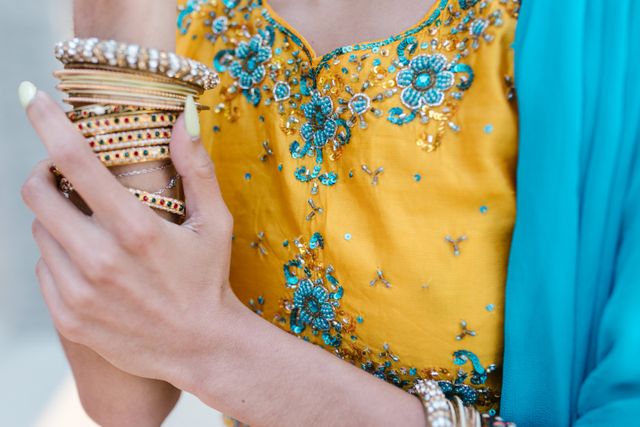
Materials also affect how embroidery is classified. Cotton and rayon threads create conventional threadwork, while zari, dabka and naqshi introduce metallic elements. Sheesha embroidery includes small mirrors secured with surrounding stitches.
Not every decorative detail is technically embroidery. Gota, appliqué, lace and fabric borders involve attaching material to the garment. However, these details are often combined with embroidered panels and are therefore relevant when examining Pakistani surface design.
The complete Pakistani Embroidery Guide explains the differences between hand embroidery, machine embroidery and related decorative construction in greater detail.
Nine Popular Embroidery Styles in Pakistani Women’s Clothing
1. Chikankari Embroidery
Chikankari is recognised for fine threadwork, floral patterns, shadow effects and areas of textured or open stitching. It is widely associated with Lucknow and the broader South Asian textile tradition.
Traditional chikankari is completed by hand, but contemporary clothing also includes machine-embroidered fabrics inspired by the technique. Product descriptions should identify the production method accurately.
White or matching thread is frequently used on light-coloured fabric, although modern chikankari is available in broader colour combinations. The decorative effect often comes from changes in stitch structure rather than strong colour contrast.
Chikankari may cover the complete shirt fabric or remain concentrated around the neckline, sleeves and front. Lawn, cotton, voile and other lightweight woven fabrics can support this embroidery when the stitch density is suitable.
The Sky Blue Chikankari Two-Piece Suit demonstrates how a chikankari shirt can be combined with plain trousers, allowing the embroidered fabric to remain the main design feature.
2. Sindhi Embroidery and Mirror Work
Sindhi embroidery includes varied regional and community-based traditions. It is commonly recognised through dense geometric patterns, bright thread colours and the use of mirrors in many forms.
Small mirrors are attached to the fabric with surrounding stitches. The threadwork must secure each piece evenly and prevent exposed edges from creating a rough finish.
Geometric arrangements may appear on shirt fronts, necklines, sleeves and borders. Repetition and alignment are important because uneven spacing becomes highly visible in structured patterns.
Modern suits may use limited mirror placement rather than covering a complete panel. This reduces the weight of the garment while retaining a clear reference to traditional sheesha work.
Mirror work requires a stable base fabric. Lightweight material may need reinforcement behind heavily decorated areas.
3. Balochi Embroidery
Balochi embroidery is known for highly organised geometric designs, dense stitching and carefully developed panels. Traditional forms vary between regions and communities, so the category should not be treated as one fixed pattern.
Embroidery is commonly placed on centre-front sections, necklines, sleeves and trouser openings. Rectangular and angular arrangements create clearly defined areas of surface work.
The work may use several thread colours, although the palette and stitch density depend on the specific tradition. Repeated motifs require accurate counting and controlled spacing.
Contemporary clothing may use smaller Balochi-inspired panels rather than reproducing a complete traditional layout. Such designs should be described as inspired by regional embroidery unless they are made through an established traditional process.
4. Phulkari Embroidery
Phulkari is associated with the wider Punjab region and is recognised for counted-thread embroidery traditionally worked on woven fabric. The name is commonly connected with floral work, although the motifs can also be geometric and highly structured.
Traditional phulkari uses long stitches arranged according to the fabric weave. Changes in stitch direction can alter how the thread reflects light and how the motif appears.
Dupattas and shawls are strongly associated with this embroidery, but phulkari details can also be used on shirt panels, sleeves and borders.
Contemporary machine embroidery may imitate phulkari colours and geometric arrangements. Authentic handwork and machine-inspired versions should be distinguished in product information.
Phulkari generally works best on stable woven fabric because the design relies on the fabric’s thread structure.
5. Aari and Chain-Stitch Embroidery
Aari embroidery uses a hooked needle to create linked chain stitches. It can produce curved floral outlines, filled motifs and continuous borders.
The technique allows the embroiderer to develop repeated stitches relatively quickly while maintaining detailed curves. Stitch size and tension should remain consistent throughout the motif.
Aari work can use cotton, silk-like, rayon or metallic threads. It may be applied to lawn, cotton, velvet, silk blends and other stable fabrics depending on the density of the design.
In Pakistani women’s clothing, aari embroidery can appear around necklines, on front panels, sleeves and dupatta borders. Contemporary versions may use a simplified floral pattern with considerable plain fabric remaining visible.
6. Zari, Dabka and Naqshi Work
Zari, dabka and naqshi are associated with metallic decorative work. These materials add texture and reflective detail but differ in structure and application.
Zari generally refers to metallic thread used for embroidery or couching. Dabka is a flexible coiled wire that is cut into sections and attached to the fabric. Naqshi is another coiled metallic material commonly used to create textured outlines and filled areas.
These components are generally applied by hand because each section must be positioned and secured individually. The base fabric may require backing to support the additional weight.
Metallic work is often placed around necklines, sleeve borders, centre panels and dupatta edges. Excessive density can make lightweight fabric stiff, so placement should be planned according to the material.
7. Gota and Applied Metallic Details
Gota work attaches metallic ribbon, shapes or narrow borders to fabric. It is technically an applied decorative method rather than thread embroidery, but it is commonly used alongside embroidered Pakistani suits.
The ribbon can form geometric motifs, borders, leaves and small repeated shapes. Its edges must be secured properly to prevent them from lifting away from the fabric.
Gota is frequently applied to dupattas, shirt hems, sleeves and neckline areas. The scale should correspond with the garment; broad metallic borders can add unnecessary weight to very light fabric.
Contemporary designs may use narrow gota lines with thread embroidery or fabric-covered buttons. This produces a controlled decorative combination without covering the complete garment.
8. Cutwork and Jaali Embroidery
Cutwork creates open areas by removing selected sections of fabric and securing the exposed edges with stitches. Jaali techniques produce mesh-like effects through thread manipulation, openwork or specialised machine embroidery.
Both require accurate finishing because weak edges may fray or expand. The remaining fabric between open sections must be strong enough to support the complete panel.
Cutwork is commonly used on sleeves, borders, necklines and shirt hems. Jaali details can appear within chikankari, floral embroidery and contemporary machine-embroidered fabric.
Light and medium-weight woven materials can support these techniques when the spacing remains appropriate. Very loose weaves may not provide enough stability for detailed openwork.
9. Contemporary Floral and Geometric Threadwork
Contemporary thread embroidery combines hand or machine stitching with motifs developed for modern two-piece and three-piece suits. Floral arrangements remain common, but abstract and geometric patterns are also widely used.
The embroidery may be concentrated on one garment area rather than distributed across the complete shirt. Neckline panels, sleeve sections and narrow borders are practical placements because they retain enough plain fabric to show the garment cut.
Machine embroidery allows motifs to be repeated consistently across ready-to-wear production. Hand-applied details may then be added to selected areas.
This is one of the broadest embroidery styles in Pakistani women’s clothing because it is not limited to one regional technique. Its quality depends on stitch security, fabric compatibility, placement and finishing.
The Lime Bloom Hand-Embroidered Three-Piece Suit represents a contemporary outfit in which hand embroidery is an important part of the complete design.
Pakistani Embroidery Styles Comparison
| Embroidery style | Main feature | Common material | Typical placement |
|---|---|---|---|
| Chikankari | Fine threadwork and open details | Cotton or rayon thread | Shirt front, sleeves and neckline |
| Sindhi embroidery | Geometric stitching and mirrors | Coloured thread and sheesha | Panels, necklines and borders |
| Balochi embroidery | Dense, structured geometry | Coloured thread | Centre panels, sleeves and trousers |
| Phulkari | Counted-thread motifs | Silk-like floss | Dupattas, panels and borders |
| Aari embroidery | Linked chain stitching | Thread or metallic yarn | Florals, necklines and borders |
| Zari and dabka | Raised metallic work | Metallic thread and coiled wire | Necklines, fronts and sleeves |
| Gota work | Applied metallic ribbon | Metallic trim | Hems, dupattas and borders |
| Cutwork and jaali | Open or mesh-like areas | Matching embroidery thread | Sleeves, necklines and hems |
| Contemporary threadwork | Modern floral or geometric motifs | Hand or machine thread | Focused shirt and dupatta sections |
These categories can overlap. A garment may combine aari embroidery with zari, use mirrors within geometric threadwork or add gota around a hand-embroidered panel.
Common Embroidery Placement
Necklines
Neckline embroidery creates a defined centre-front detail. The motif should follow the shape of the neck opening and remain balanced on both sides.
Dense embroidery should not extend into seam allowances unless the pattern accounts for the additional thickness.
Shirt Fronts
The shirt front provides space for centre panels, scattered motifs or a complete embroidered surface. Placement should correspond with the shirt length and cut.
Short shirts generally require smaller or more concentrated motifs, while long shirts provide more space for vertical panels.
Sleeves and Cuffs
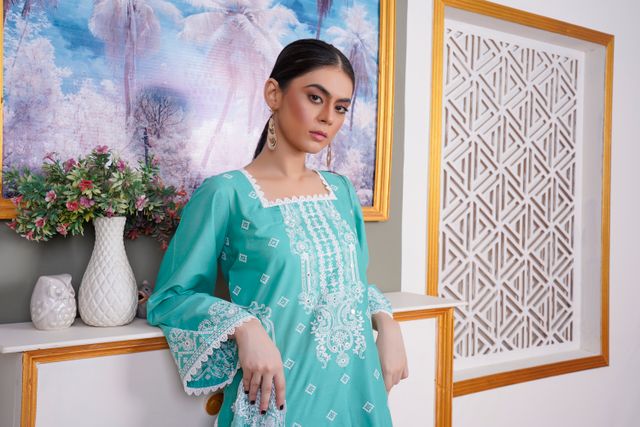
Sleeve embroidery may appear near the cuff, along the outer arm or across the complete sleeve. Placement should remain consistent on the left and right sides.
Heavy metallic or mirror work near the cuff can affect the sleeve opening, so the base fabric must provide sufficient support.
Hems and Side Openings
Embroidered borders can define shirt hems and side openings. The pattern should finish cleanly at the opening instead of being cut through an incomplete motif.
Horizontal borders should remain level across the front and back panels.
Trousers and Shalwars
Straight trousers may carry embroidery near the ankle or side seam. Shalwars require additional planning because gathers, pleats and overlapping sections can alter motif placement.
Embroidery placed on a balloon shalwar may become concentrated where the material gathers. Farshi and tulip shalwars need motifs positioned according to their wider or overlapping panels.
Dupattas
Dupattas may use embroidered borders, scattered motifs or detailed end panels. The decorative weight should remain balanced so one section does not pull more heavily than another.
Suitable Fabrics for Different Styles
Lawn and lightweight cotton work well with chikankari, fine thread embroidery and controlled cutwork. Dense metallic work may require reinforcement because these fabrics have limited body.
Medium-weight cotton supports aari, chain stitch, mirror work and regional geometric embroidery. Its stable weave provides a reliable base for repeated stitches.
Khaddar and light khaddar can support stronger thread and larger motifs. Embroidery should be planned around the fabric texture because extremely small stitches may not remain clearly visible.
Linen and slub linen provide a textured surface for contemporary embroidery. Simple motifs and focused placement generally remain clearer than very dense fine stitching.
Silk and silk-based fabrics can support zari, dabka, naqshi and detailed threadwork. The stitch tension must be controlled to prevent puckering or visible puncture marks.
Additional technical information about fibres and textile construction is available through The Textile Institute. Educational resources on hand-embroidery methods can also be found through the Royal School of Needlework.
Traditional and Contemporary Embroidery
Traditional embroidery is often connected with regional knowledge, established motifs and specific production methods. Contemporary embroidery can retain these features while adjusting the colour, scale and placement.
A traditional embroidered panel may cover a large shirt section. A modern suit may use a smaller related motif around the neckline or sleeves. This can reduce garment weight and allow the shirt construction to remain more visible.
Modern clothing also includes machine versions of patterns associated with hand techniques. These products can provide consistent decorative fabric, but they should not be presented as fully handmade when the work is machine produced.
Updated garment cuts create additional placement requirements. Drop shoulders, short kurtis, co-ord sets and kaftans provide different panel shapes from traditional straight shirts.
The relationship between garment construction and surface work is examined further in Traditional vs Contemporary Pakistani Women’s Clothing and How Modern Cuts Are Changing Pakistani Eastern Wear.
YASHAM® Embroidered Clothing
YASHAM® uses embroidery and decorative fabrics across multiple suit categories. The Sky Blue Chikankari Two-Piece Suit combines an embroidered long shirt with plain trousers, keeping the chikankari fabric visually clear.
The Lime Bloom Hand-Embroidered Three-Piece Suit places hand embroidery within a coordinated three-piece design.
The Blush Farshi Sheesha Silk Three-Piece Suit represents the use of sheesha-related decorative detail on a smooth silk-based fabric.
The Pearl Grace Korean Silk Three-Piece Suit demonstrates how a silk-based material can support a structured contemporary three-piece outfit.
These products are part of the broader range of modern eastern wear for women, including embroidered suits, co-ords, kaftans and updated shalwar designs.
Frequently Asked Questions
Which embroidery styles are most common in Pakistani clothing?
Common styles include chikankari, Sindhi mirror work, Balochi embroidery, phulkari, aari, zari, dabka, cutwork and contemporary floral threadwork. Their use varies according to garment type, fabric and production method.
Is mirror work a form of embroidery?
Mirror work uses embroidery stitches to secure reflective pieces to fabric. The mirrors are attached components, while the surrounding threadwork forms the embroidered structure.
What is the difference between zari and dabka?
Zari generally refers to metallic thread used in embroidery or couching. Dabka is a flexible coiled wire cut into sections and attached to the fabric with thread.
Is gota considered embroidery?
Gota is an applied decorative technique rather than conventional thread embroidery. Metallic ribbon or shapes are attached to the fabric and may be combined with embroidered details.
Can traditional embroidery be machine produced?
Machines can imitate the appearance of many traditional motifs, but the production method is different. Machine embroidery should not be described as hand embroidery merely because it uses a traditional pattern.
Which embroidery is suitable for lightweight lawn?
Fine threadwork, controlled chikankari, small floral motifs and carefully spaced cutwork are suitable for lawn. Dense mirrors and heavy metallic components may require additional support.
Can several embroidery styles be used on one garment?
Yes. A design may combine thread embroidery, zari, mirrors, cutwork or decorative borders. The materials should remain compatible with the fabric and should not create unnecessary weight.
Final Overview
Embroidery styles in Pakistani women’s clothing reflect regional craftsmanship, garment construction and contemporary production. Chikankari uses fine thread and open details, while Sindhi and Balochi techniques are recognised through structured regional patterns. Phulkari, aari, zari, sheesha and cutwork introduce different stitches, materials and levels of surface texture.
A garment should be evaluated through its stitch security, motif placement, fabric compatibility and finishing rather than the amount of decoration alone. Accurate descriptions should also distinguish genuine hand embroidery from machine-produced or traditionally inspired work.
Explore embroidered Pakistani suits through the YASHAM® online shop and view the wider clothing collection on the official YASHAM® website. New products and brand updates are also shared through the official YASHAM® Instagram profile.