
Printed Co-ord Sets for Women: Design and Construction
Printed co-ord sets for women combine separate garments through a shared print, colour palette and fabric direction. In Pakistani eastern wear, a co-ord set commonly consists of a printed shirt and coordinated trousers designed as one complete outfit.
The strength of a printed co-ord depends on more than using the same fabric across both garments. The scale and direction of the print, shirt length, shoulder construction, trouser shape, seam alignment and finishing all affect the completed design.
Some sets repeat one print across the shirt and trousers, while others use related patterns or place a stronger motif on one garment. Both approaches can work when the components remain visually connected and their cuts are planned together.
This guide explains how printed co-ord sets for women are developed, from fabric and print selection to pattern cutting and final construction.
Table of Contents
- What Are Printed Co-ord Sets for Women?
- How Printed Co-ord Sets Are Designed
- Seven Essential Design and Construction Features
- Shirt Cuts Used in Printed Co-ord Sets
- Trouser Construction in Women’s Co-ords
- Suitable Fabrics for Printed Co-ord Sets
- Print Placement and Pattern Alignment
- Construction Quality Checklist
- YASHAM® Printed Co-ord Sets
- Frequently Asked Questions
What Are Printed Co-ord Sets for Women?
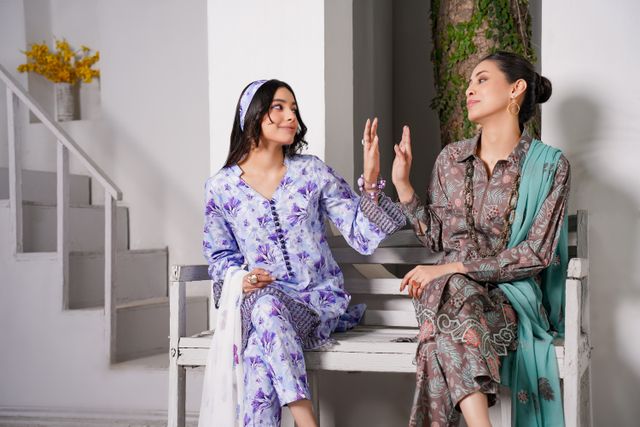
Printed co-ord sets for women are matching separates developed to function as one coordinated design. Unlike two unrelated garments made from similar colours, a co-ord set is planned through a consistent print, fabric and set of proportions.
A standard eastern co-ord usually includes a shirt and trousers. The shirt may be short, straight, boxy or loose fitting, while the lower garment may be straight, wide or moderately tapered.
Printed co-ords are also different from conventional three-piece suits. They usually place greater emphasis on the relationship between two main garments rather than adding a separate dupatta as another design layer.
The category is part of the broader development of modern eastern wear for women, which also includes kaftans and contemporary Pakistani suits.
How Printed Co-ord Sets Are Designed
The design process normally begins with the fabric and the intended garment proportions. The print must be evaluated according to its repeat, direction, motif size and colour distribution before the pattern pieces are positioned.
A small repeated print is comparatively easy to distribute across a shirt and trousers. A large floral or geometric design requires more planning because key motifs may become divided by the neckline, armholes, centre seams or trouser panels.
The shirt and trousers should also be considered together. A wide shirt paired with very wide trousers may use too much fabric across both sections. A shorter or more controlled shirt can provide clearer separation when the lower garment is broad.
Printed co-ord sets for women can use matching prints from top to bottom, but the garment boundaries should remain identifiable. Neckline finishing, sleeve construction, hems and trouser seams provide the necessary structure.
Seven Essential Design and Construction Features
1. Coordinated Print Direction
Print direction is one of the first details that must be checked. Some fabrics use motifs that can be viewed from either direction, while others have a clear top and bottom.
Directional prints should face consistently across the shirt front, back, sleeves and trousers. A motif placed upright on the shirt but reversed on one trouser panel creates a visible construction problem.
Border prints require additional planning. The border may be placed along the shirt hem or sleeve opening, but the same border should not be repeated on the trousers without considering the proportions of the complete set.
The print direction must therefore be confirmed before any main pattern piece is cut.
2. Balanced Motif Scale
The motif scale should work across both the upper and lower garments. Small and medium-scale prints are generally easier to repeat because they remain clear on sleeves, trouser legs and shorter panels.
Large motifs can still be used, but their placement needs to be controlled. A large flower or geometric section should not be cut awkwardly at the neckline or positioned unevenly across the trouser legs.
Printed co-ord sets for women may also combine a large shirt motif with a smaller related pattern on the trousers. This creates coordination without repeating exactly the same visual weight across the complete outfit.
3. Appropriate Shirt Proportions
The shirt cut determines how the printed fabric is displayed. Straight shirts provide clear vertical panels, while boxy and loose-fit shirts offer a wider uninterrupted surface.
Short shirts create a stronger separation between the upper and lower garments. Medium-length shirts provide additional coverage but should include suitable side openings when paired with wider trousers.
The shirt width should relate to its length. A short shirt can support a wider body, while a long shirt usually benefits from more controlled side seams.
Modern shirt proportions are discussed further in the guide explaining how modern cuts are changing Pakistani eastern wear.
4. Planned Trouser Shape
The trousers should support the shirt rather than repeat its full width without control. Straight trousers are widely used because they create a clean lower structure beneath printed shirts.
Wide-leg trousers can also be included, particularly when the shirt is short or moderately loose. Their print placement must remain consistent across the broader leg panels.
Tapered trousers provide more definition near the ankle, but the pattern should allow the fabric to retain its printed design without excessive gathering.
A printed trouser also requires careful cutting because differences between the left and right legs are more visible than on plain fabric.
5. Accurate Seam Alignment
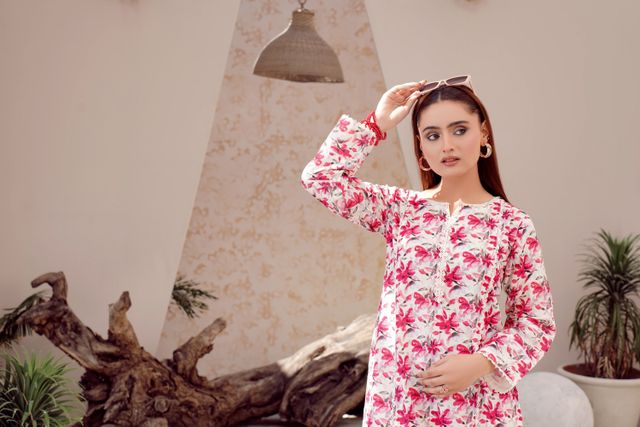
Matching every motif across every seam may not always be possible, particularly with limited fabric or irregular prints. However, important design lines should remain consistent.
Horizontal stripes, borders and strong geometric sections require accurate alignment. If a pattern crosses a side seam, major lines should meet at the same height.
The shirt’s centre front, shoulder seams and sleeve attachments also require attention. On symmetrical prints, incorrect positioning can make the complete garment appear uneven even when the stitching is technically secure.
Accurate seam alignment is one of the details that distinguishes professionally constructed printed co-ord sets for women from garments cut without print planning.
6. Stable Neckline and Openings
A printed shirt still requires a clearly finished neckline. V-necklines, round necklines, slit openings and banded necks can all work when their proportions suit the garment.
Facing, piping or binding may be used to stabilise the neckline. Printed fabric can make construction faults less obvious from a distance, but uneven curves or stretched openings remain quality issues.
Side openings should also be reinforced at their upper point. Their height should correspond with the shirt length and trouser width.
Trouser waist openings, pockets and hems require similarly stable finishing. Each detail must function without interrupting the overall print more than necessary.
7. Consistent Garment Finishing
Both pieces of a co-ord set should maintain the same production standard. A well-finished shirt cannot compensate for uneven trouser seams, and accurately constructed trousers cannot correct a distorted neckline.
Seam allowances should be controlled throughout both garments. Hems should remain even, sleeve lengths should match and trouser legs should have consistent width.
Buttons, piping and other details should repeat colours already present in the print. Introducing several unrelated details can weaken the coordination between the garments.
Professional finishing ensures that printed co-ord sets for women function as complete outfits rather than separate items made from the same material.
Shirt Cuts Used in Printed Co-ord Sets
Straight Shirt
A straight shirt uses relatively consistent width from the armholes to the hem. It provides clear front and back areas for repeated prints and can be produced in short, medium or long lengths.
The cut works particularly well with geometric patterns and vertical print arrangements because the side seams do not expand heavily toward the hem.
Boxy Shirt
A boxy shirt is usually shorter and wider than a standard straight kameez. Its broad front panel provides space for medium or large motifs.
The shoulder may be regular or slightly extended. Sleeves should remain controlled so the upper garment does not become excessively wide.
Loose-Fit Shirt
A loose-fit shirt provides additional room without necessarily using a flared hem. Drop shoulders, half sleeves and a straight lower edge are common features.
This construction works well with printed co-ord sets for women because it presents the pattern across a relatively uninterrupted surface.
Medium-Length Shirt
A medium-length printed shirt can be paired with straight or moderately wide trousers. Side openings prevent the lower section from restricting the trousers.
The print should remain balanced across the extended front and back. Large motifs need particular attention because more of the pattern becomes visible on a longer shirt.
Trouser Construction in Women’s Co-ords
Straight Trousers
Straight trousers maintain a consistent or slightly narrowed width from the hip toward the ankle. They provide a controlled base for short, loose and medium-length shirts.
Their simpler construction also makes print alignment easier than on highly shaped trousers.
Wide-Leg Trousers
Wide-leg trousers distribute fabric evenly from the upper leg toward the hem. They create a broader printed area and require careful motif placement across both legs.
When the trousers are wide, the shirt should use controlled volume so that both garments remain individually clear.
Tapered Trousers
Tapered trousers narrow gradually toward the ankle. They can balance a boxy or loose shirt without introducing a completely straight lower shape.
The taper should be developed through the side and inseam patterns rather than by creating irregular gathers near the ankle.
Shaped Shalwars
Some contemporary co-ords use balloon or tulip shalwars instead of standard trousers. These garments require additional print planning because gathers, curved seams or overlapping panels can alter the appearance of the pattern.
A printed balloon shalwar may concentrate motifs where the fabric is gathered. A tulip shalwar can divide the print where its curved panels overlap.
These more complex lower garments are therefore less straightforward than standard co-ord trousers.
 Suitable Fabrics for Printed Co-ord Sets
Lawn and Cotton
Lawn and lightweight cotton support printed co-ords intended for warmer weather. They accept detailed prints and can be used for straight or loose-fit shirts with matching trousers.
Their lightweight structure requires stable neckline, pocket and side-opening finishes.
Light Khaddar
Light khaddar has more body and visible texture than lawn. It is suitable for printed co-ord sets because it can retain a boxy shirt, straight trouser and defined hem.
The added structure also helps repeated prints remain clear across larger garment sections.
Linen and Linen Blends
Linen blends provide texture and can support plain or printed separates. Their weight and surface should be checked before selecting a very wide shirt or trouser.
A stable linen blend can maintain straight seams, while a lighter blend may produce a softer garment shape.
Dhanak and Other Seasonal Fabrics
Dhanak has more body and is generally used for cooler temperatures. Printed dhanak can support coordinated sets, although its weight may require narrower proportions than lightweight lawn.
The main fabric should be tested for opacity, print clarity, shrinkage behaviour and seam performance before production begins.
Broader textile education and information about fabric development are available through The Textile Institute. Information about cotton production and more responsible industry practices can also be found through Better Cotton.
Print Placement and Pattern Alignment
Print placement begins when the paper pattern is arranged on the fabric. The grainline, motif direction and repeat must all be checked before cutting.
For symmetrical shirt fronts, the central area should appear balanced. This does not always mean placing one large motif exactly at the centre, but the left and right sides should not look unintentionally unequal.
Sleeves should be cut with matching direction. If the print contains large motifs, their position on each sleeve should be reasonably consistent.
Trouser panels need the same attention. Strong vertical lines should run in the intended direction, while major motifs should not appear at noticeably different heights on the two legs unless the fabric uses an intentionally irregular design.
Pockets can interrupt printed fabric. Patch pockets may be aligned with the main pattern, while inseam pockets preserve more of the exterior print. The chosen construction should suit the garment rather than being added without planning.
Construction Quality Checklist
| Construction area | What should be checked |
|---|---|
| Print direction | Motifs face consistently across all main panels |
| Shirt front | Central print distribution appears balanced |
| Sleeves | Length, direction and motif position are consistent |
| Shoulder seams | Major print lines are not visibly displaced |
| Side seams | Borders and horizontal elements align where possible |
| Neckline | Shape is even and the fabric does not stretch |
| Side openings | Both openings begin at the same height |
| Trouser legs | Width, length and print direction match |
| Waist construction | Elastic, band or fastening sits evenly |
| Hems | Shirt, sleeves and trousers have clean, consistent depth |
These checks apply to matching two-piece suits as well as printed co-ord sets for women. The main difference is the stronger expectation of visual coordination across co-ord separates.
YASHAM® Printed Co-ord Sets
YASHAM® uses light khaddar and coordinated prints to create contemporary two-piece sets. The Tangerine Bloom Light Khaddar Printed Set demonstrates how one print direction can connect a shirt and trousers.
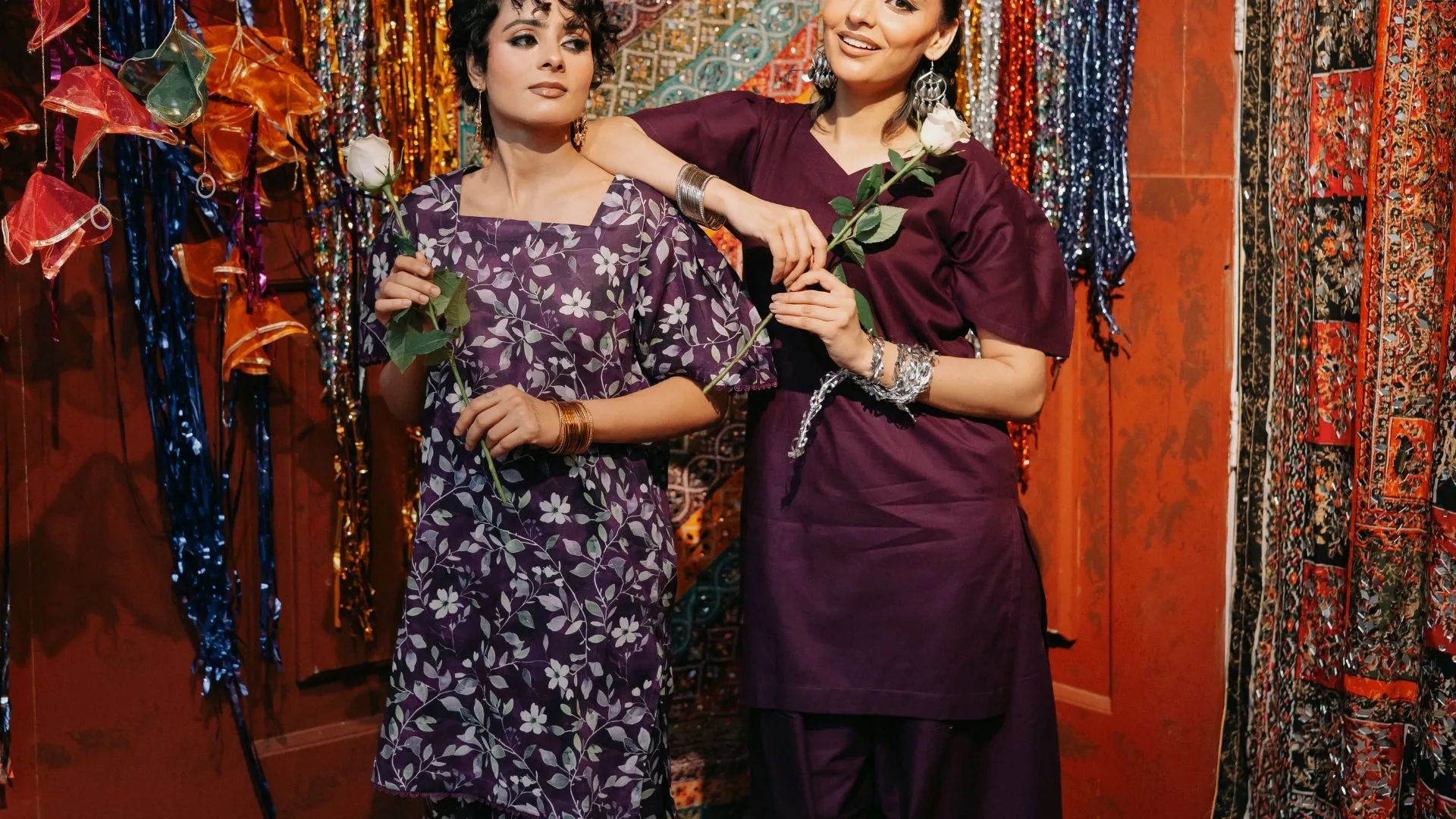
The Plum Hour Light Khaddar Printed Co-ords Set provides another example with a darker colour direction and matching two-piece construction.
A plain coordinated alternative can be seen in the Forest Whisper Khaddar Co-ord Set. Comparing plain and printed sets shows how much additional planning is required for motif placement and pattern alignment.
These sets demonstrate the position of Pakistani co-ords between conventional eastern suits and modern matching separates.
Frequently Asked Questions
What makes a printed outfit a co-ord set?
A printed outfit becomes a co-ord when its separate garments are deliberately coordinated through fabric, print, colour and proportion. Using similar colours alone does not provide the same level of design consistency.
Should the shirt and trousers use exactly the same print?
Not necessarily. Both pieces can use the same print, related patterns or different print scales within one colour palette. The garments should still appear intentionally connected.
Which shirt cut works best for printed co-ords?
Straight, boxy and controlled loose-fit shirts all work well. The most appropriate cut depends on the trouser width, fabric weight and print scale.
Are printed trousers harder to construct than plain trousers?
Printed trousers require additional planning because the direction and placement of motifs must remain consistent across both legs. Strong stripes, borders and geometric prints demand particularly accurate cutting.
Can light khaddar be used for printed co-ord sets?
Yes. Light khaddar provides enough structure for shirts and trousers while supporting clear printed designs. It is particularly suitable when a set requires more body than lawn.
How are printed co-ords different from traditional two-piece suits?
Traditional two-piece suits may combine a printed shirt with plain trousers. Printed co-ords usually establish a stronger visual connection between both garments through matching or related fabric.
Final Overview
Printed co-ord sets for women require coordinated design at every stage of development. Fabric selection, print direction, motif scale, shirt proportions and trouser construction must be planned before the pattern pieces are cut.
Accurate seam alignment and consistent finishing help the separate garments function as one complete outfit. The strongest sets use print with control rather than allowing the pattern to hide construction problems.
Explore additional co-ords and contemporary Pakistani clothing through the YASHAM® online shop and view the wider collection on the official YASHAM® website. Product releases and brand updates are also available through the official YASHAM® Instagram profile.