
Farshi Shalwar Guide: History, Design, 7 Types and Modern Pakistani Styles
Farshi shalwar is a wide, flowing lower garment recognised by its generous volume, gathered construction and floor-length appearance. It is commonly paired with a kurti or kameez to create a traditional two-piece or three-piece eastern outfit. Although the design is linked with older South Asian clothing traditions, the modern Pakistani farshi shalwar has been adjusted for present-day stitching, movement and practical wear.
The farshi shalwar is sometimes confused with a gharara, sharara, palazzo or ordinary shalwar. These garments may look similar because they all use wider cuts, but their construction is different. A farshi design usually carries substantial volume from the upper section down to its broad hem, while other trousers may be fitted at the thigh, flared from the knee or cut in a straighter shape.
This guide explains farshi shalwar history, construction, major types, fabric selection and modern Pakistani versions. It also covers the details that should be examined when evaluating a stitched farshi suit.
Table of Contents
- What is a farshi shalwar?
- Farshi shalwar history and cultural background
- Main farshi shalwar design features
- Farshi shalwar compared with similar trousers
- Seven important farshi shalwar types
- Modern Pakistani farshi shalwar styles
- Suitable fabrics for a farshi design
- How to evaluate stitching and construction
- How to select the right design
- Frequently asked questions
What Is a Farshi Shalwar?
The term “farshi” is connected with farsh, a Persian-derived word referring to the floor or ground. In clothing, the term describes a garment with a hem that reaches, rests on or appears to sweep close to the floor. A farshi shalwar therefore gets its identity from its length and width rather than from colour, print or decoration.
A traditional farshi garment used a considerable amount of fabric to produce an extended lower shape. Historical versions could be long enough to require the wearer to lift part of the garment while walking. Modern designs are generally more controlled. They preserve the broad shape and floor-length appearance while reducing excessive trailing fabric.
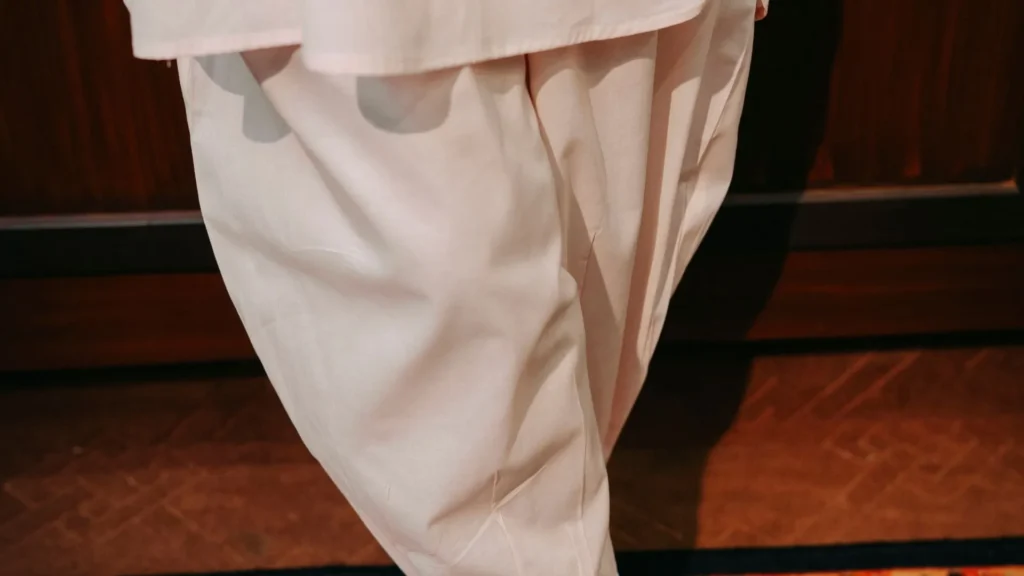
The present-day farshi shalwar for women normally has a fitted or adjustable waistband, fabric gathered or pleated below the waist and a significantly wide lower section. Some designs use separate panels or kalis to distribute the volume. Others use a broad pattern cut with gathers concentrated around the waistband.
A farshi shalwar suit may be plain, printed, embroidered or constructed in contrasting colours. Its defining feature remains the shape of the lower garment. A wide palazzo worn with a kurti does not automatically become a farshi shalwar because the pattern, gathers, fall and hem structure may be different.
Farshi Shalwar History and Cultural Background
The history of this garment is connected with several overlapping clothing traditions rather than one simple point of origin. Wide trousers have been worn across parts of Central Asia, West Asia and South Asia for centuries. As these forms entered different regions, local tailors changed their proportions, fabric use and accompanying upper garments.
The historic farshi pajama is particularly associated with the courtly clothing of Awadh and Lucknow. It was worn by women in wealthy and aristocratic households and was recognised by its very long, wide lower section. A documented overview of the farshi pajama describes it as an important part of formal women’s clothing in the courts of Oudh, where extensive fabric and detailed surface work reflected social status.
It is important, however, not to treat every modern farshi shalwar as an exact copy of the historic farshi pajama. The older version could extend considerably across the floor and was often part of a highly formal ensemble. Modern Pakistani versions retain the visual width but normally use more manageable lengths, lighter construction and practical waist finishing.
South Asian clothing developed through continuing interaction among regional, Persian, Central Asian and local design traditions. The Hong Kong Palace Museum’s overview of Mughal court culture explains how Mughal artistic production combined influences from South Asia, Iran, Central Asia, China and Europe. This broader cultural exchange helps explain why it is difficult to assign many historic garments to one isolated design source.
Following changing social patterns and the growth of ready-to-wear fashion, heavily extended farshi garments became less common in ordinary wardrobes. Their basic shape nevertheless remained relevant in formal clothing, family collections, film costumes and traditional tailoring. Pakistani designers have since adapted that shape into stitched suits that retain its recognisable width without reproducing every historical feature.
Pakistan’s textile culture also includes extensive regional weaving, dyeing and embroidery traditions. The establishment of Pakistan’s first dedicated textile museum reflects growing interest in documenting these materials and the communities that produce them. Contemporary eastern wear exists within this wider textile history, even when specific cuts are simplified for modern production.
Main Farshi Shalwar Design Features
Wide, Gathered Construction
A farshi shalwar requires enough fabric to create visible width. The volume may be formed through gathers, pleats, panels or a combination of these methods. Good construction distributes the fabric evenly so that one area does not appear unnecessarily bulky.
Floor-Length Appearance
The lower edge is designed to reach close to the floor. Modern versions should create this appearance without producing so much excess length that ordinary movement becomes difficult. The final fall depends on the garment’s cut, fabric weight and stitching.
Broad Hem
Unlike a conventional shalwar that narrows towards the ankle, a farshi shalwar has a much broader lower section. The hem may be plain, finished with a border, printed or decorated. A clean hem finish is particularly important because the width makes it highly visible.
Defined Waistband
The waistband supports a larger amount of fabric than a straight trouser. It must therefore be properly structured and securely stitched. Depending on the pattern, it may use elastic, a drawstring, a fixed belt or a combination of fastening methods.
Balanced Shirt Length
A kurti with farshi shalwar is usually proportioned to keep the width of the lower garment visible. Short and medium-length kurtis are common in modern Pakistani designs. A longer kameez can also work, but its cut must avoid hiding the main structure of the shalwar.
Controlled Drape
Fabric weight affects the complete shape. A fabric that is too stiff may stand away from the body, while an excessively thin fabric may not hold the intended volume. The most effective material provides enough movement while maintaining a clear outline.
Farshi Shalwar Compared With Similar Trouser Designs
Understanding the differences between traditional trousers prevents incorrect product descriptions and makes it easier to identify the correct garment.
Farshi Shalwar vs Traditional Shalwar
A conventional shalwar is wide at the waist and upper leg but normally narrows towards the ankle. It may finish with a cuff or compact opening. A farshi shalwar continues into a broad, floor-length lower section instead of tapering sharply.
Farshi Shalwar vs Gharara
A gharara is generally fitted from the waist to the knee. It then expands below a visible knee joint, often finished with decorative trim. Farshi construction does not depend on a fitted upper leg or a pronounced knee seam.
The terms “farshi gharara” and “farshi pajama” are sometimes used in historical or commercial descriptions. However, a standard gharara and a contemporary farshi shalwar should not be treated as identical products.
Farshi Shalwar vs Sharara
A sharara consists of two wide, separate legs that often create a skirt-like appearance. Its flare can begin from the waist or upper thigh. While both garments can be voluminous, farshi shalwar design places greater emphasis on gathered construction and a hem that reaches or visually spreads towards the floor.
Farshi Shalwar vs Palazzo
Palazzo trousers usually have a straight or gradually widening leg. Their construction is comparatively simple and often uses less gathering around the waist. A farshi design generally has more concentrated volume and a stronger connection with traditional eastern tailoring.
7 Important Farshi Shalwar Types
Modern Pakistani collections use the term for several practical variations. These are not rigid historical categories; they describe the most common ways the design is produced and presented today.
1. Plain Farshi Shalwar
A plain farshi shalwar relies on colour, proportion and stitching instead of surface print. The absence of a pattern makes the volume and hemline easier to see. Plain coordinated sets can use one colour throughout, as demonstrated by a yellow farshi shalwar two-piece set with a matching kurti and lower garment.
This format requires clean construction because uneven gathers, poorly finished seams and irregular hems are more noticeable on an uninterrupted surface.
2. Printed Farshi Shalwar
Printed designs introduce pattern across the shirt, shalwar or both pieces. Print scale matters because the lower garment contains more fabric than a standard trouser. Large motifs can become dominant, while smaller repeated prints create a more evenly distributed appearance.
A purple printed farshi shalwar set shows how print can be incorporated while retaining the traditional outline.
3. Solid-Colour Coordinated Set
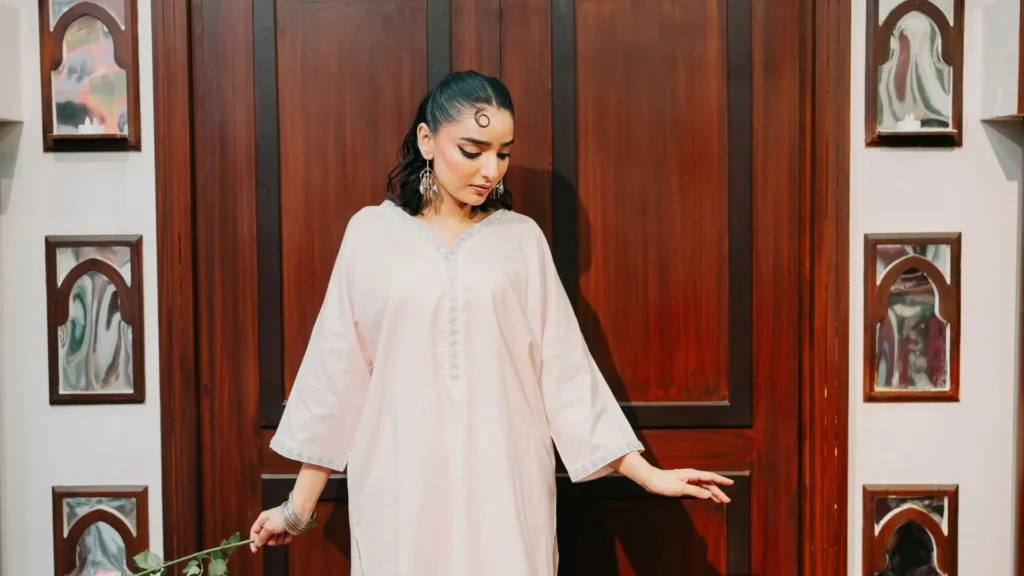
A coordinated design uses the same colour across the kurti and shalwar. This gives the outfit a unified appearance and places attention on its construction details, such as sleeve shape, neckline finish and gathered volume.
The purple farshi shalwar two-piece set is an example of a solid-colour approach in a stitched format. This type can include decorative tailoring without requiring a contrasting print.
4. Contrasting Farshi Shalwar Set
A contrasting set combines different colours across the upper and lower garments. The contrast separates the two shapes clearly and allows the width of the shalwar to remain visible.
For example, the maroon and white farshi shalwar set combines a darker shirt with a light lower garment. Colour contrast can be used effectively without heavy embellishment when both pieces have balanced proportions.
5. Floral Farshi Shalwar
Floral farshi designs may place the pattern on the kurti, lower garment or both. Pattern placement must be planned during cutting so important motifs are not broken unnecessarily at the seams.
The blue floral and white farshi shalwar set represents a design in which a floral element is balanced with a plain piece. This combination keeps the print visible without making the complete outfit visually crowded.
6. Black and White Printed Farshi Shalwar
Black-and-white combinations use strong tonal contrast and clear print definition. Because the palette is limited, the scale and placement of the pattern become important design features.
A black and white printed farshi shalwar set can combine a traditional silhouette with a more graphic surface treatment. The print should remain properly aligned where practical, particularly across prominent panels.
7. Punjabi Farshi Shalwar
Punjabi versions commonly pair a voluminous shalwar with a shorter kurti and clear sleeve or neckline details. The design may be plain, printed or brightly coloured. Its distinction comes from the overall proportion and regional influence rather than from one required decoration.
The orange Punjabi farshi shalwar set uses a short kurti, shaped sleeves and a wide lower garment to create this proportion in a stitched two-piece format.
Modern Pakistani Farshi Shalwar Styles
The modern Pakistani farshi shalwar is designed to preserve traditional width while improving control and wearability. Instead of an extended trail, most stitched versions finish close to the floor. This adjustment maintains the intended outline while reducing unnecessary fabric around the feet.
Short kurtis are frequently used because they keep the gathered upper section visible. Round necklines, V-cut details, puff sleeves and straight sleeves can provide definition to the shirt without competing with the lower garment. Printed shalwars are also paired with plain shirts to distribute visual detail more carefully.
Contemporary sets may use either matching or contrasting colours. Matching colour creates continuity, while contrast separates the kurti from the farshi shape. Neither approach is automatically more traditional; the final result depends on the cut, fabric and finishing.
Ready-to-wear construction has also changed how the garment is produced. Standardised panels, secure waistbands and controlled lengths make the design easier to manufacture consistently. These changes explain why a present-day stitched farshi shalwar suit can look traditional without copying the extensive proportions of a court garment.
Suitable Fabrics for a Farshi Shalwar Design
Fabric selection determines whether the lower garment falls smoothly or appears stiff and bulky. The appropriate choice also depends on season, print method, construction and the amount of fabric required.
Lightweight cotton and lawn-based materials can support summer farshi shalwar designs when they are not excessively thin. They allow the gathers to move easily and can carry printed patterns clearly. Medium-weight cotton blends offer slightly more structure and may hold pleats or panels more effectively.
Linen and blended textured materials create a firmer outline. They must be cut carefully because excessive thickness at the gathered waistband can produce unnecessary bulk. Khaddar and other heavier fabrics may work for cooler conditions when their weight is considered during pattern development.
Silk and silk-blend materials provide a fluid fall suitable for refined designs. Slippery materials require accurate cutting, seam control and secure finishing. Embellished fabrics also need balanced decoration because the shalwar already uses a substantial quantity of material.
The fabric should ultimately support three requirements: manageable gathering at the waist, a clear fall through the length and a properly finished broad hem.
How to Evaluate Farshi Shalwar Stitching and Construction
A well-made farshi shalwar should be evaluated beyond colour and print. Its structure determines how the garment sits and moves.
First, examine the distribution of gathers or pleats. They should appear balanced rather than concentrated unevenly at one side. Excessive thickness around the waistband can indicate that the fabric has not been controlled correctly.
Second, check the panel seams. They should sit flat and remain secure along the full length. In printed garments, thoughtful pattern placement improves the finished appearance even when perfect matching is not possible.
Third, inspect the hem. Because it is broad and close to the floor, inconsistent length becomes visible quickly. The hem should follow an even line and should not twist because of uneven cutting.
Fourth, review the waistband and fastening. It must support the weight of the lower garment without losing its shape. Elastic and drawstring components should be properly enclosed and securely attached.
Finally, consider the relationship between the kurti and shalwar. The shirt should provide enough space for normal movement while maintaining a clear proportion with the wide lower garment. A well-balanced set treats both pieces as parts of one design.
How to Select a Farshi Shalwar
Begin by deciding whether you prefer a plain, printed or contrasting design. Plain colours place greater attention on construction, whereas prints add visible detail. A plain kurti with a printed shalwar offers a balanced option between the two.
Next, assess the amount of volume. Some modern styles use a very broad hem, while others use controlled width for easier movement. Product images showing the complete lower garment are more useful than close photographs that display only the shirt.
Review the shirt length and sleeve construction as part of the complete silhouette. A shorter kurti makes the upper gathers more visible, while a medium-length shirt produces greater coverage. Neither length changes the basic identity of the farshi shalwar, but it changes the overall proportion.
Colour placement should also be considered. Dark and light contrast creates a clear separation between pieces. A single-colour set produces a more continuous appearance, while floral or graphic prints make the lower garment more prominent.
Finally, examine product information for clear descriptions of the cut, finishing and number of pieces. A specific product name is more useful than a general “traditional suit” label because it allows buyers to distinguish a true farshi shape from a palazzo or regular shalwar.
Frequently Asked Questions About Farshi Shalwar
What makes a shalwar a farshi shalwar?
Its defining features are generous width, gathered or panelled construction, a broad hem and a length that reaches close to the floor. Colour and decoration can vary without changing the basic garment type.
Is a farshi shalwar the same as a farshi pajama?
The terms are related and are sometimes used interchangeably. However, historic farshi pajama designs could be significantly longer and more elaborate. A modern Pakistani farshi shalwar is usually a practical adaptation with controlled length and volume.
Is a farshi shalwar the same as a gharara?
No. A conventional gharara is normally fitted above the knee and flares below a visible knee joint. A farshi shalwar generally carries its volume through a larger section of the garment and does not require that fitted knee structure.
Can a farshi shalwar be printed?
Yes. The garment can be plain, printed, floral, embroidered or made with contrasting panels. Its classification depends mainly on the cut and floor-length shape rather than its surface design.
Why is a short kurti commonly paired with a farshi shalwar?
A short kurti keeps the gathered section and width of the lower garment visible. It also creates a clear separation between the structured upper piece and voluminous shalwar. Medium-length shirts may also be used when their cut remains balanced.
Are modern farshi shalwars exact copies of historical designs?
Usually not. Modern stitched versions reduce excessive trailing length, use contemporary waist construction and may include current sleeve, neckline and print treatments. They preserve important visual features while adapting the garment for present-day production.
Understanding the Farshi Shalwar as a Modern Traditional Garment
The farshi shalwar remains identifiable because of its wide construction, broad hem and floor-length appearance. Its historic associations give the design cultural context, while modern Pakistani tailoring has made it more practical and easier to include in ready-to-wear collections.
A clear understanding of the garment requires attention to pattern construction rather than marketing terminology alone. Farshi designs should be distinguished from ghararas, shararas, palazzos and conventional shalwars by examining their waistband, volume, panels and lower finish.
To review current stitched interpretations, explore the complete women’s eastern wear selection through the YASHAM® online shop. You can also visit the official YASHAM® website for product details and follow YASHAM® on Instagram for new designs, collection updates and product visuals.