
What Is a Kaftan? Design, Fit and Main Features
What is a kaftan, and how is it different from other long garments for women? A kaftan is generally a loose, extended garment with a wide body, long length and relaxed fit. It may have full sleeves, an open or closed front, a defined neckline and side openings depending on its construction.
Modern kaftans are available in plain, printed and embroidered forms. Some retain a very wide traditional cut, while others use controlled side seams, separate sleeves and shaped shoulders to create a more structured fit. Pakistani kaftan designs commonly combine long proportions with printed fabric, V-necklines and full sleeves.
The kaftan is now an important category within modern eastern wear because it provides a complete garment without following the standard shirt-and-trouser construction. Understanding its main features makes it easier to distinguish a properly constructed kaftan from a loose maxi, abaya or oversized dress.
Table of Contents
- What Is a Kaftan in Women’s Eastern Wear?
- Basic Kaftan Construction
- Seven Main Features of a Kaftan
- How Should a Kaftan Fit?
- Common Kaftan Fabrics
- Printed and Plain Kaftan Designs
- Kaftan Compared with Similar Garments
- Modern Pakistani Kaftans
- Frequently Asked Questions
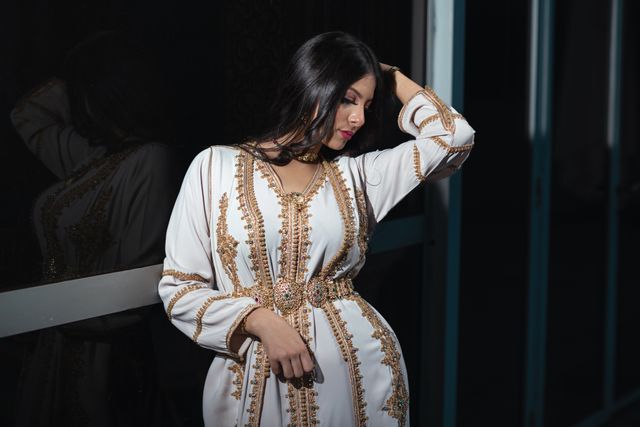
What Is a Kaftan in Women’s Eastern Wear?
A kaftan is a long garment recognised by its loose body and extended cut. It usually falls below the knees and may reach the ankles. Unlike a standard kameez, it is not normally shaped closely around the waist, hips or lower body.
The garment has appeared in different forms across several regions and historical periods. Its exact shape, fabric and decoration have varied considerably. A general historical definition can be found through Encyclopaedia Britannica’s kaftan reference.
In contemporary Pakistani clothing, a kaftan is usually treated as a complete long garment rather than a traditional shirt that must be paired with a visible shalwar or trouser. However, some designs may still be worn with an inner trouser when required by the fabric or side openings.
A Pakistani kaftan may include local prints, embroidered necklines, border details, full sleeves and fabric suitable for regional seasons. These details allow it to remain connected to eastern clothing while using an updated ready-to-wear structure.
Basic Kaftan Construction
A basic kaftan begins with an extended front and back. Traditional forms may use broad, nearly rectangular sections, while modern patterns can include shaped side seams, separate sleeves and more clearly defined shoulders.
The width of the body is one of its most important construction features. A kaftan needs enough fabric to maintain a loose fit, but excessive width can make the garment difficult to control. Contemporary designs often reduce the body width while retaining the long length and relaxed structure.
The neckline may be cut directly into the front panel and finished with facing, piping, binding or a separate band. V-necklines and round necklines are common because they create a clear centre-front detail.
Sleeves can be cut as part of the body or attached separately. An integrated sleeve produces a wider upper section, while a separate sleeve provides greater control around the shoulder and armhole.
The side seams may remain closed to the hem or include openings. When side openings are used, their height should be planned carefully so the garment retains appropriate coverage and the lower panels hang evenly.
Seven Main Features of a Kaftan
1. Long Garment Length
Length is one of the clearest answers to the question, what is a kaftan? Most kaftans extend below the knee, while many reach the ankle. This separates them from standard short kurtis and medium-length shirts.
The length should remain balanced with the garment’s width. A very wide kaftan with inadequate length can appear boxy, while a narrow ankle-length garment may look more like a straight maxi dress.
A properly planned kaftan maintains enough length to establish its extended shape while allowing the fabric to hang correctly from the shoulders.
2. Loose Body Fit
A kaftan does not normally follow the body closely. Its front and back panels provide space through the chest, waist and hips. This loose construction is a functional part of the garment rather than simply an oversized fit.
Modern kaftans can still have controlled proportions. Side seams may narrow slightly or include shaping without turning the garment into a fitted dress. The objective is to preserve room through the body while keeping the overall cut organised.
The loose fit should begin at the upper body and continue consistently. A kaftan that pulls across the chest or hips will not retain its intended construction.
3. Wide or Extended Sleeves
Kaftan sleeves may be wide, straight, integrated or separately attached. Traditional cuts often extend the upper body fabric into the sleeve area, creating a broad line across the shoulders and arms.
Modern full-sleeve kaftans may use a separate armhole and sleeve. This provides greater control over sleeve width and helps the garment sit more clearly around the shoulders.
Sleeve openings can be plain or finished with borders, piping and printed details. Their width should relate to the main garment rather than adding unnecessary fabric to an already loose cut.
4. Defined Neckline
Although the body of a kaftan is loose, its neckline usually provides a clear point of structure. V-necklines are common because they create definition at the centre front. Round, slit and banded necklines may also be used.
Neckline finishing is particularly important on lightweight fabric. Facing, binding or piping helps the opening retain its shape and prevents the fabric from stretching.
Printed kaftans may place a contrasting border around the neckline. Embroidered versions may concentrate surface work in the same area. In both cases, the detail should follow the neckline accurately.
5. Continuous Front and Back Panels
Many kaftans use large front and back panels with limited interruption from waist seams. This continuous construction distinguishes them from dresses with separate bodices and skirts.
The large panels also provide space for prints and embroidery. However, their scale requires careful cutting. A central motif should remain properly positioned, and borders should align across the hem and sleeve openings where possible.
Some modern kaftans introduce vertical panels to control width or combine fabrics. These variations can still be recognised as kaftans when the long, loose body remains the dominant feature.
6. Side Seams or Side Openings
A kaftan may have straight side seams, curved side seams or openings near the lower hem. These details determine how the garment’s width is distributed.
Closed side seams create a complete dress-like structure. Side openings provide more separation between the front and back panels and may allow an inner trouser to remain partly visible.
Openings should have clean edge finishing because they receive repeated pressure during wear. Reinforcement at the top of each opening also helps prevent the seam from separating.
7. Printed, Plain or Embroidered Surface
Fabric and surface details play an important role in defining a modern kaftan. Printed kaftans use the broad garment panels to display patterns, while plain designs rely more strongly on construction and fabric quality.
Embroidery may be placed around the neckline, front panel, sleeves or hem. A controlled placement keeps the design clear and prevents the garment from becoming unnecessarily heavy.
Borders can also be used to frame the neckline, sleeves and lower edge. Their scale should be suitable for the garment length and should remain aligned across matching sections.
How Should a Kaftan Fit?
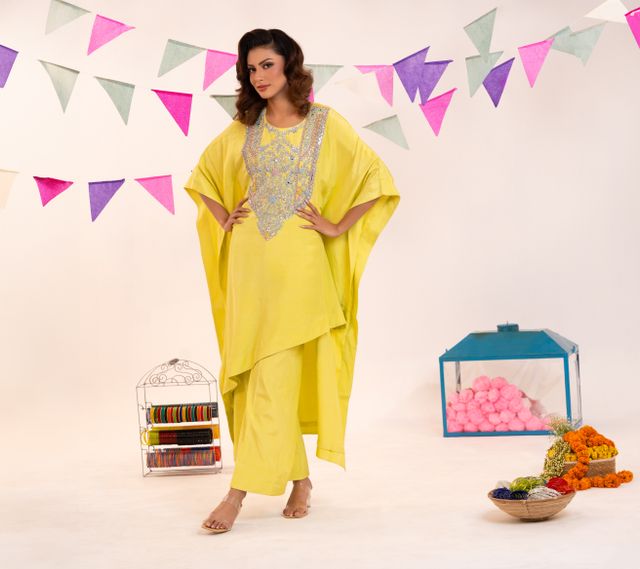
A kaftan should have a relaxed fit through the body without pulling across the chest, waist or hips. At the same time, the neckline and shoulders should remain properly positioned.
The shoulder construction depends on the pattern. A kaftan with integrated sleeves may not have a conventional shoulder seam, while a structured design may use regular or slightly dropped shoulders. In both cases, the garment should sit evenly without shifting heavily toward the front or back.
Sleeves should provide enough room through the upper arm and elbow. Excessively wide sleeves may interfere with the garment’s balance, particularly when the body is already very broad.
The lower panels should fall evenly. If one side appears shorter, the issue may be related to cutting, shoulder alignment or uneven fabric distribution.
A kaftan should also maintain sufficient width without appearing uncontrolled. The difference between a loose kaftan and an oversized garment lies in the placement of the neckline, shoulders, sleeves and side seams.
Common Kaftan Fabrics
Lawn and Lightweight Cotton
Lawn and lightweight cotton are suitable for printed kaftans intended for warmer weather. These fabrics support clear prints and provide less weight across the long garment.
Because lightweight fabrics can stretch around openings, the neckline and side seams require stable finishing. Large printed panels should also be cut accurately to keep the pattern centred.
Linen and Linen Blends
Linen and linen blends provide more visible texture. They can support plain, printed and minimally embroidered kaftans.
The fabric weight should be considered carefully. A heavier linen blend may add too much structure to a very wide kaftan, while a lighter blend can support a controlled loose fit.
Khaddar and Light Khaddar
Light khaddar can be used for kaftans designed for cooler temperatures. It provides more body than lawn and can retain straight side seams and defined sleeve shapes.
Full-weight khaddar may require a narrower cut because combining heavy fabric with excessive width can make the finished garment bulky.
Silk and Smooth Blends
Silk-based fabrics create a smoother surface and can support printed or embroidered kaftans. These fabrics require accurate seams because uneven stitching may be more visible.
Smooth fabric can also change how the kaftan hangs. The pattern should provide enough width for a loose fit without relying on stiffness to hold the garment’s shape.
Readers looking for broader technical information about fabric properties and textile construction can consult educational resources from The Textile Institute.
Printed and Plain Kaftan Designs
Printed kaftans are particularly common because their large front and back panels provide substantial space for pattern. Floral, geometric and abstract prints can all be used, provided their scale suits the garment.
Large prints require careful positioning around the centre front, neckline and hem. Small repeated prints are easier to distribute but should not become overly dense across a long garment.
Plain kaftans depend more on fabric texture, seams and finishing. Piping, buttons, neckline embroidery or a limited border can provide definition without covering the entire surface.
A combination of plain and printed fabric is also possible. Printed panels may appear at the centre front or sides, while plain fabric controls the main body. The two materials should have compatible weight so the garment hangs evenly.
Kaftan Compared with Similar Garments
| Garment | Main construction | Typical fit | Defining feature |
|---|---|---|---|
| Kaftan | Long front and back with wide body | Loose | Extended length and generous cut |
| Maxi dress | Dress structure with varied seams | Fitted or loose | Long dress length |
| Abaya | Long outer garment | Loose | Designed primarily as an outer layer |
| Kameez | Shirt worn with trousers or shalwar | Straight, fitted or loose | Separate upper garment |
| Co-ord shirt | Part of a matching set | Varies | Designed with a coordinated lower garment |
A maxi dress may include a shaped waist, fitted bodice or flared skirt, while a kaftan generally maintains a looser body. An abaya is commonly constructed as an outer garment, whereas a kaftan may function as a complete dress or a primary fashion garment.
A kameez is normally one part of a suit and is paired with a shalwar or trouser. A kaftan does not depend on the same shirt-and-trouser division.
These differences help answer what is a kaftan without defining it only by length or looseness.
Modern Pakistani Kaftans
Modern Pakistani kaftans combine the extended garment shape with regional fabrics, prints and neckline details. Full sleeves and V-necklines are particularly common because they provide practical coverage and a clearly defined front.
The Blue Printed Kaftan for Women from YASHAM® uses a long cut, full sleeves and a V-neckline. Its printed surface is distributed across the garment rather than being limited to a small section.
The Sea Green Printed Kaftan for Women provides another example of a full-length printed design with the same important construction features.
Kaftans are one category within the broader guide to modern eastern wear for women, alongside co-ord sets and contemporary Pakistani suits.
Frequently Asked Questions
What is the main feature of a kaftan?
The main feature is its long, loose body. Most kaftans provide considerable room through the chest, waist and hips while maintaining an extended length.
Is a kaftan always ankle length?
No. Many kaftans reach the ankles, but some finish around the calf or below the knee. The garment should still retain a long proportion and loose construction.
Does a kaftan always have wide sleeves?
Kaftans commonly have wide or relaxed sleeves, but modern versions may use straight, controlled full sleeves. The sleeve design should remain consistent with the width of the body.
What is the difference between a kaftan and an abaya?
A kaftan can function as a complete fashion garment and may use prints, structured necklines and varied sleeve designs. An abaya is traditionally designed as a loose outer garment and generally has a different functional purpose.
Can a kaftan have separate sleeves?
Yes. Modern kaftans frequently use separately attached sleeves and defined armholes. This construction provides greater control around the shoulder and upper arm.
Are Pakistani kaftans usually printed?
Printed kaftans are common in Pakistani eastern wear, but plain and embroidered versions are also available. The choice depends on the fabric and intended design direction.
Final Overview
The answer to what is a kaftan lies in its complete construction rather than one individual feature. A kaftan is usually long and loose, with extended body panels, relaxed sleeves, a defined neckline and sufficient width through the body.
Modern versions may use controlled side seams, separate sleeves, printed fabrics and focused embroidery while retaining the garment’s recognised structure. Fabric weight, neckline stability, panel alignment and edge finishing determine how clearly the final design is presented.
Explore current kaftan designs through the YASHAM® online shop and view the complete clothing range on the official YASHAM® website. New products and collection updates are also shared through the official YASHAM® Instagram profile.